
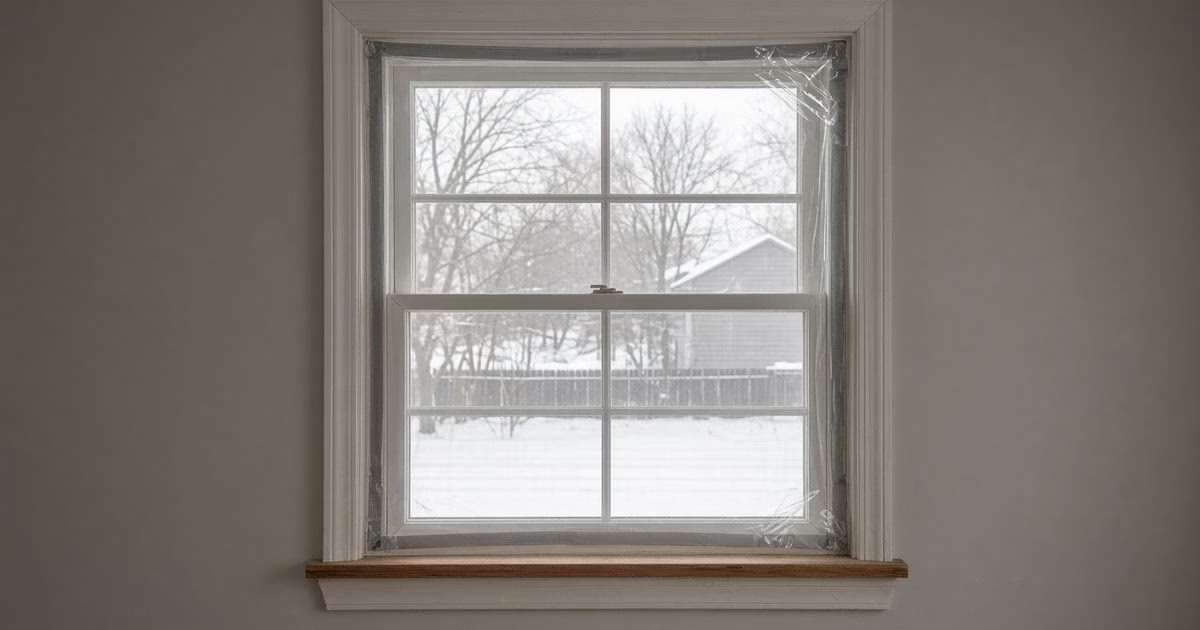
Short answer: A heat-shrink plastic kit is a cheap, temporary way to take the chill off a drafty or cold window for one winter, as long as you don’t need to open that window until spring. A glass-applied window film is a different product that does a different job: mainly cutting summer heat, glare and UV, and in its low-e versions holding back some radiant heat in winter. Neither one seals the gaps around a sash or frame, repairs rot, stops rain getting in, or clears fog trapped inside a failed double-pane unit. If the window rattles, leaks air at the sash or won’t lock, repair and weatherstripping come first. If the frame is soft, water is getting in, several glass seals have failed or the window no longer works, that’s when a replacement quote, or a quote for glass-only or component repair, deserves your time.
This guide sorts out which fix matches which symptom. It draws on the U.S. Department of Energy’s Energy Saver guidance, the ENERGY STAR plastic-window project guide, the Efficient Window Coverings guide to applied films, 3M’s published kit FAQ and warranty bulletin, the International Window Film Association’s FAQ and Pilkington’s technical bulletin on films applied to glass. All were accessed November 10, 2026. Manufacturer and trade-association statements are labeled as theirs. We haven’t tested any kit or film, and none of the options below is right for every window.
Quick answer: film, repair or a replacement quote?
- Temporary film can help when the window is sound but the room is cold near the glass, or air seeps past an old sash, and you can live with the window staying shut through the cold months. That’s a shrink kit’s job.
- Glass film can help when the complaint is summer heat, glare or fading through glass that’s otherwise in good shape. Low-e versions add some winter benefit, but only after you confirm the film suits your glass.
- Repair comes first when the sash rattles, won’t lock tight, has worn weatherstripping, loose glazing or broken hardware. No film reaches those problems.
- Get a quote when wood is soft or rotted, water comes in around the frame, fog sits between the panes of more than one sealed unit, or the window no longer opens, closes or locks after repair. Ask whether glass-only or component repair is possible before pricing whole windows.
Not all window film is the same
“Window insulation film” gets used for three or four different products. They install in different places, solve different problems and carry different risks, so it’s worth naming them precisely before comparing anything to replacement.
Heat-shrink plastic kits over the trim
These are the seasonal kits sold in hardware stores. Double-sided tape goes around the window trim, a thin sheet of clear plastic is pressed onto the tape, and a hair dryer shrinks it tight. The plastic doesn’t touch the glass; it traps a layer of still air between itself and the window. The Department of Energy’s fall and winter tips describe the same idea: tape clear plastic film to the inside of the window frames during the cold months, or use a heavy-duty clear plastic sheet on a frame, and make sure the plastic is sealed tightly to the frame to help reduce infiltration. 3M describes its indoor kits as heat-shrink film held by double-sided mounting tape, marketed to keep cold drafts out and warm air in. Those are the manufacturer’s claims; 3M’s kit pages don’t give a performance figure.
Films applied directly to the glass
Applied window films are thin, permanent layers stuck to the glass itself, usually by a professional installer. The Efficient Window Coverings guide describes them as an adhesive, a polyester film and a scratch-resistant coating, with tints, UV blockers or low-emissivity coatings added depending on the product. Most are solar-control films, designed to cut solar heat gain, glare and UV. Some carry a low-e coating facing the room, which reflects radiant heat back indoors in winter. The same guide is direct about the main limitation: applied films do not reduce air leakage.
Factory low-e glass is a different thing again
A low-e coating applied at the factory, as part of a sealed double-pane unit, isn’t the same as a retrofit low-e film. When you compare a film’s claims against replacement windows, you’re comparing an add-on layer on old glass with a whole new glass package. And if your windows already have factory low-e glass, adding film needs care: Pilkington’s technical bulletin says films should never be applied to the room-side surface of insulating glass units that carry a low-e coating on that surface, and the International Window Film Association says whether film suits low-e windows depends on the type and location of the low-e coating and the benefit you’re after.
Rigid interior inserts
Acrylic or glass panels that press into the window opening are a sturdier, removable cousin of the shrink kit. They’re a bigger purchase with their own fit, moisture and emergency-exit questions, which we cover in our guide to interior storm window inserts. This page stays with shrink kits and glass films.
Match the fix to the symptom
Start from what you can actually see and feel at the window. The table below is our own matrix built from the sources on this page. It doesn’t rank products; it tells you what each symptom usually points to and where film fits, if at all.
| Symptom | What it usually means | Try first | Can film help? | When to get a quote |
|---|---|---|---|---|
| Draft at the sash or meeting rail | Worn weatherstripping, a sash that doesn’t close tight, missing or loose locks | Weatherstripping, sash locks, adjustment | A shrink kit can cover it for a winter. Glass film can’t. | Repair doesn’t stop it, or the sash is damaged |
| Air leaking around the trim or casing | Gaps between the window frame and the wall | Find the leak, then caulk or seal the gap | Limited. A kit taped to the trim face doesn’t reach a gap behind the trim. | Leak points to failed installation or a damaged opening |
| Cold glass, no moving air | Single-pane or older glass losing heat at the surface | Insulating shades or drapes, a second layer | Yes. A shrink kit adds an air layer; a low-e film can reflect some radiant heat back in. | You want a long-term fix and the windows are near the end of their life anyway |
| Summer heat, glare or fading | Solar gain through clear glass | Shades, awnings or exterior shading | Yes, this is what solar-control film is for. Check glass compatibility first. | Rarely the reason on its own |
| Condensation on the room side of the glass | High indoor humidity meeting a cold surface | Bring indoor humidity down, use exhaust fans | A kit may keep the inner surface warmer, but sealing plastic over a wet frame hides the problem | Water damage, rot or staining around the window |
| Fog or haze between the panes | The seal of the sealed glass unit has failed | Check the window or glass warranty | No. Nothing on the room side reaches inside a sealed unit. | Ask about glass-only replacement first; whole window if several units or frames are failing |
| Soft, rotted or cracked frame or sill | Water damage or decay | Find the water source; probe the extent of the damage | No. Film can hide it while it gets worse. | Damage is beyond a local repair |
| Won’t open, close or lock | Broken balances, hardware, warped sash | Hardware or balance repair | No | Repair parts aren’t available or the sash is warped |
If you’re not sure where a draft is coming from, our guide to drafty windows walks through how to find it, and our repair vs. replace guide goes deeper on glass-only swaps and component repair.
Shrink kits: installation and limits
How the installation works
The ENERGY STAR project guide for plastic over windows lays out a short sequence: read the instructions on the box, size the film with a few inches to spare on each side, clean the window frame, apply the tape and then the film, and use a hair dryer to tighten it. It lists a kit, scissors or a utility knife, a hair dryer, a tape measure, and rubbing alcohol for cleaning. Buy a kit that fits the width of your window, since the film comes in window-sized pieces.
If you have mini blinds, ENERGY STAR describes a workaround: take the rotating wand off before you apply the film, reinforce the spot around the wand hook with overlapping strips of tape, cut out the center with a fresh blade, then reattach the wand.
Surfaces and paint
3M’s FAQ says its indoor kit can go on painted, stained or varnished window trim, and that the tape shouldn’t be applied to painted walls. ENERGY STAR says the tape removes easily without damaging the finish when winter is over. Paint and finishes vary, so if the trim is freshly painted, fragile or historic, test a short piece of tape somewhere out of sight first. Other kit makers publish their own surface lists, so follow the instructions on the box you actually buy.
Indoor vs. outdoor kits
3M sells both. Its FAQ says the indoor film is meant to be shrunk with a hair dryer, while the outdoor film should not be, because sunlight can over-shrink it, and the outdoor tape is made for colder temperatures. 3M says indoor film can go up in many temperatures, but suggests a bright, sunny day if it’s below 0°F outside. Its outdoor kit is meant to be applied when it’s above 50°F outside.
The limits you should plan around
- The window is sealed shut. Once the film is on, you can’t open that window without cutting or removing the film. Leave at least one openable window per room you’ll want to air out, and think carefully before filming a bedroom window that’s someone’s emergency exit. If you do, everyone in the room should know the film can be torn through, and nothing should block the way.
- It’s seasonal. ENERGY STAR’s own instructions end with taking the plastic down when winter is over and pulling the tape off the trim.
- It doesn’t seal the wall. A kit covers the window from trim to trim. A leak between the frame and the wall, behind the trim, still needs caulk or sealant. If the giveaway is a whistle on windy days, here is how to find where the wind is getting through before you cover anything.
- Check for moisture before you seal. Don’t put film over a window with water on the sill, soft wood or peeling paint at the bottom of the sash. Deal with the water first.
- Inspect when it comes down. Spring removal is a good time to look at sills, glazing and the bottom rail for damage that built up over winter.
3M markets its kits as reducing condensation and saving heating costs. That’s a manufacturer claim without a published figure, and how much any kit helps depends on your windows, climate and how well the film is sealed.
What glass-applied films can and can’t do
What they’re good for
DOE’s Energy Saver advice for warm weather suggests sun-control or other reflective films on south-facing windows to reduce solar heat gain, and in hot climates on east-, west- and south-facing windows too. For cold weather, it suggests applying low-e film on the inside of windows to keep heat from radiating out. The Efficient Window Coverings guide lists the main benefits as reduced solar heat gain, reduced glare, strong UV blocking, privacy, and reduced heat loss when a low-e coating is the innermost layer, with no daily operation or maintenance.
On fading, the International Window Film Association is careful: film can reduce the UV that causes fading, but no window film can eliminate it.
What they can’t do
- Stop air leaks. The Efficient Window Coverings guide lists this as a drawback in plain terms. A drafty sash stays drafty with film on the glass.
- Give back winter sun. Solar-control films also cut the free solar heat a south window collects in winter. The guide recommends non-low-e solar-control films mainly where cooling needs are moderate to significant, and low-e products in any climate.
- Come off easily. The same guide says removal takes special procedures and release agents and should be done by professionals.
- Rule out condensation. It also notes condensation potential can increase when a low-e coating is the innermost exposed layer.
Thermal stress: why the glass type matters
Film that absorbs sunlight makes the glass hotter, and uneven heating stresses glass. The International Window Film Association says thermal stress from absorbed solar radiation is the one kind of glass stress film may affect, and that film manufacturers publish film-to-glass tables for their factory-trained dealers. If you’re unsure, the association says to ask for a copy of those guidelines.
Glass makers are stricter. Pilkington’s bulletin on field-applied films says such applications should be checked for thermal stress with the film supplier, advises against applying solar-control film to the room-side surface of annealed insulating glass, and, as noted above, rules out film on room-side low-e surfaces altogether.
Check the window warranty before anyone films the glass
Applying film can affect the warranty on the window or its sealed glass. 3M’s own warranty bulletin for its window films says the seller will match the original glass manufacturer’s seal-failure warranty if applying the film voids that warranty, and ties coverage to recommended glass types and registration by the dealer. Pilkington’s bulletin says it doesn’t warrant against glass breakage, however caused. So before you sign:
- Find your window or glass warranty and read what it says about aftermarket films.
- Ask the installer which film-to-glass recommendation covers your exact glass, and for a copy.
- Get the film’s own warranty in writing, including any glass-breakage or seal-failure coverage and what you must do to keep it.
How long a film lasts depends on the product. The window film association says effective life varies with the film, the glass, the window construction, which way the glass faces and where you live, and that quality films are warranted by their manufacturers. The Efficient Window Coverings guide notes that window films are rated by the National Fenestration Rating Council for solar heat gain and visible light, so ask for the rated values of the exact film you’re quoted.
Film vs. inserts vs. repair vs. replacement
This is a scope comparison, not a price list. It shows what each option is built to do and what it leaves untouched. It’s based on the sources on this page and on our interior inserts guide.
| Option | Main job | Air leaks | Using the window | How long it stays | Main watch-outs |
|---|---|---|---|---|---|
| Heat-shrink plastic kit | Adds a still-air layer for cold months | Covers sash leaks while sealed to the trim; not leaks behind the trim | Window stays shut until the film comes down | One season, then removed | Egress, ventilation, trim finish, moisture hidden behind film |
| Glass-applied film | Cuts solar heat, glare and UV; low-e versions reflect some heat indoors | No effect | Window works normally | Long-term; varies by film, glass and exposure | Thermal stress, low-e compatibility, window warranty, professional removal |
| Rigid interior insert | Adds a removable second layer of glazing | Can reduce leakage through the window when it seals well | Panel comes out to open the window | Multi-year, removable | Fit, condensation behind the panel, quick removal for emergency exits |
| Repair and weatherstripping | Restores the window you have | Main fix for sash leaks | Window works normally | Ongoing maintenance | Doesn’t warm single glass or stop noise through it |
| Glass-only replacement | Replaces a failed sealed unit in a sound frame | Not its job | Window works normally | New glass unit | Frame and sash must be in good shape |
| Full window replacement | New glass, sash and frame | New seals and, if installed well, a sealed opening | Window works normally | New unit | Installation quality, flashing, scope of the quote |
When to request a replacement quote
Film and kits are comfort tools. They don’t make a failing window sound. These are the signs that it’s time to price real work:
- Structural damage. Soft or crumbling wood at the sill, sash or frame joints, cracked frames, or a sash that has warped out of shape.
- Recurring leaks. Water coming in around the frame or staining the wall below the window after rain.
- Glazing faults. Fog between the panes of sealed units. One unit in a sound frame is usually a glass-only repair; several, in aging frames, can tip the balance toward replacement.
- Operating defects repair won’t fix. Windows that still won’t open, close or lock after hardware and balance repair, or parts that are no longer available.
Ask for the scope in writing either way. A repair or glass-only quote should list each window and exactly which parts are replaced. A replacement quote should name the product, the installation method for each opening, how flashing, trim and disposal are handled, and both the product and installation warranties. Our window quote checklist covers every line to look for, and are new windows worth it? looks at when replacement actually pays off and when repair wins.
Frequently asked questions
Does plastic window insulation film actually work?
It can take the edge off cold glass and seal over a leaky sash for a winter. DOE includes it among its cold-weather tips, as long as the plastic is sealed tightly to the frame. It won’t fix the window, and how much it helps depends on your windows and how well it’s installed. No universal savings figure applies.
Is shrink film the same as low-e window film?
No. A shrink kit is a loose sheet of plastic taped to the trim and taken down each spring. Low-e window film is a permanent coated film bonded to the glass, usually by a professional. They install differently, last differently and carry different risks.
Will window film stop drafts?
Glass-applied film won’t. The Efficient Window Coverings guide says applied films don’t reduce air leakage. A shrink kit can cover a leak at the sash while it’s sealed to the trim, but it won’t reach a gap between the frame and the wall. Weatherstripping and sealing fix drafts at the source.
Can I put window film on low-e or double-pane windows?
Sometimes. The window film association says it depends on the type and location of the low-e coating and what you want the film to do, and Pilkington rules out film on a room-side low-e surface. Ask the installer for the film-to-glass recommendation that covers your exact glass.
Will window film void my window warranty?
It can. 3M’s warranty bulletin offers to match the original seal-failure warranty if the film voids it, which tells you the risk is real. Read your window warranty before any film goes on the glass.
Can I open a window with a shrink kit on it?
Not without cutting or removing the film. Leave an openable window in rooms you need to ventilate, and think twice before filming a bedroom window that’s an emergency exit.
Is film cheaper than replacement windows?
Compare like with like: film plus whatever repair the window still needs, against replacement for the same windows, with both priced in writing. Film is a much smaller job, but it also does far less.
Next step
If the symptom matrix pointed you toward replacement, or you want to know what you’d be comparing a winter of film against, start with our window replacement cost calculator. It gives a planning range, not a quote, so you can see what replacement would involve before you call anyone. If the windows are sound and the problem is cold glass you’d rather solve for longer than one season, our interior storm window inserts guide is the next retrofit step to look at.
Sources
- U.S. Department of Energy, Energy Saver, “Fall and Winter Energy-Saving Tips,” energy.gov. Accessed November 10, 2026.
- U.S. Department of Energy, Energy Saver, “Windows, Doors, and Skylights,” energy.gov. Accessed November 10, 2026.
- ENERGY STAR, “Applying Plastic Over Windows,” energystar.gov. Accessed November 10, 2026.
- Efficient Window Coverings, “Applied Film,” efficientwindowcoverings.org. Accessed November 10, 2026.
- 3M, “Window Insulator Kit FAQs” (Home Improvement sealing tapes page) and Indoor Window Insulator Kit product page, 3m.com. Accessed November 10, 2026. Manufacturer statements.
- 3M, “3M Window Films and 3M IPA for Flat Glass Applications Warranty Bulletin” (dated March 1, 2026), PDF. Accessed November 10, 2026. Manufacturer warranty terms.
- International Window Film Association, “Frequently Asked Questions,” iwfa.com. Accessed November 10, 2026. Trade association.
- Pilkington North America, Technical Bulletin ATS-113, “Field Applied Plastic Films and Coatings on Vision Glass” (April 2025), PDF. Accessed November 10, 2026. Glass manufacturer guidance.