
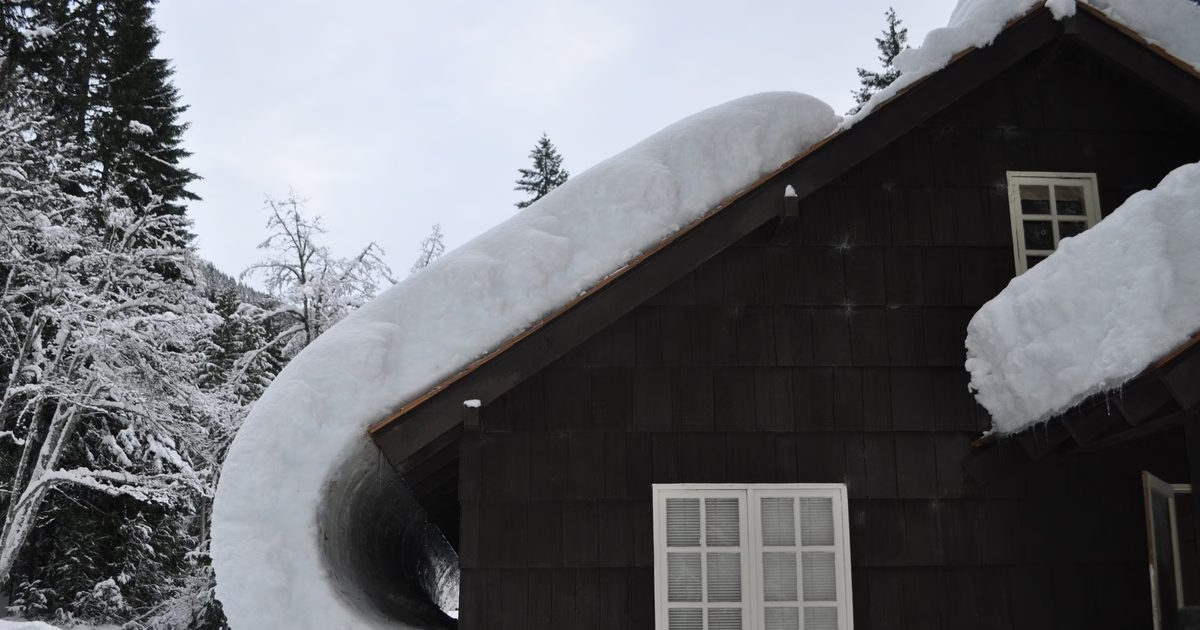
Short answer: There’s no number of inches that’s safe for every roof, because what loads a roof is the weight of the snow, not its depth. FEMA’s Snow Load Safety Guide puts one foot of fresh snow anywhere from about 3 pounds per square foot for light, dry powder to about 21 pounds per square foot for wet, heavy snow, and ice weighs far more than either. How much your roof can carry depends on the load it was designed for where you live, its shape, where snow drifts on it, and its condition. Most houses get through ordinary winters without anyone touching the snow. What matters is knowing the warning signs, getting everyone out if you see them, and leaving rooftop snow removal to insured professionals.
Get out and call for help if you notice any of these
FEMA, the Building America Solution Center run by Pacific Northwest National Laboratory (PNNL) for the Department of Energy, and Massachusetts public safety officials all describe the same signs that a roof may be overstressed. If you see or hear any of these during or after heavy snow, get everyone out of that part of the house first and make phone calls second:
- A roof line or ceiling that is visibly sagging or newly bowed
- Popping, cracking or creaking sounds from the roof or attic
- Doors or windows that suddenly won’t open or close, or that pop open on their own
- New cracks in walls, ceilings or masonry
- Severe roof leaks
- Pipes or electrical conduit at the ceiling that have started to bow
Massachusetts advises leaving the building right away if you see signs of roof damage or suspect a gas leak, without touching light switches on the way out, and calling 911 once you’re outside. FEMA and PNNL both say the next step after evacuating is an inspection by a qualified professional engineer. Don’t go back in to clear snow, and don’t climb up to take a look.
Context helps here. A door that sticks every winter, or a hairline crack you’ve watched for years, isn’t news. What deserves attention is a change that shows up during a heavy snow event, especially more than one sign at once.
Why snow weight matters more than inches
“How many inches can my roof take?” is the natural question, but depth on its own doesn’t tell you much. A foot of fluffy powder and a foot of wet, heavy snow put very different loads on the same roof. FEMA’s figures for one foot of fresh snow run from about 3 to about 21 pounds per square foot, depending on how wet it is.
Snow also changes after it lands. It settles and gets denser, it soaks up rain, and it partly melts and refreezes. A new storm piles onto what’s already there. PNNL gives an example: two feet of old snow plus two feet of new snow could weigh as much as 60 pounds per square foot of roof. That’s why a roof that carried a big storm without trouble can be in a different position after a second storm, a rain-on-snow day or a stretch of thaw and refreeze. PNNL specifically tells owners to keep an eye on roofs and decks during heavy snow, and especially after melt-refreeze cycles, rain on snow, or repeated storms.
Fresh, packed and wet snow, and ice
These are the figures the primary sources give. They’re rough guides, not a way to calculate your roof’s safety.
| Type | What the sources say | What it means for you |
|---|---|---|
| Light, dry fresh snow | About 3 pounds per square foot for one foot of depth (FEMA P-957; PNNL) | The lightest case. Deep powder can still add up, and it rarely stays this light. |
| Wet, heavy fresh snow | About 21 pounds per square foot for one foot of depth (FEMA P-957; PNNL) | The same depth can weigh many times as much as dry powder. |
| New snow, by water content | 10 to 12 inches of new snow equals about 1 inch of water (PNNL) | Most of a fresh snowfall’s depth is air. |
| Old, packed snow | 3 to 5 inches of old snow equals about 1 inch of water (PNNL) | Settled snow packs the same water into far less depth, so it’s much heavier inch for inch. Shrinking depth doesn’t mean a lighter roof. |
| Ice | About 5 pounds per square foot per inch, or about 57 per foot (FEMA P-957; PNNL) | A modest-looking layer of ice can weigh more than a lot of snow. |
Where you live matters too. FEMA notes that snow in the West is generally lighter, while East Coast snow tends to be wetter and denser. PNNL makes the same point and flags the Northwest and coastal Alaska as exceptions where snow can be wet.
Roof shape, drifting and your local design load
Ground snow load is not your roof load
Building codes start from the ground snow load: the weight of snow on open, flat ground at your location. Designers use it to work out the roof snow load, which FEMA explains also depends on wind exposure, the roof’s slope and shape, obstructions on it, and whether the space underneath is heated. FEMA is blunt that measuring the snow on the ground and assuming the roof carries the same load is incorrect. The snow on your roof can be lighter than the ground (where wind scours it off) or much heavier (where it drifts and piles up).
The load your roof is supposed to carry is set locally. PNNL points to the ground snow load maps in the International Residential Code and says the local building authority should be consulted for the correct design roof snow load. If you want to know what your home was designed for, your local building department is the place to ask. An older house, an addition built to different standards, or a roof with rot or damaged framing may carry less than you’d assume, which is why PNNL singles out older and poorly built homes.
Where snow piles up
Snow rarely sits evenly. FEMA and PNNL both describe uneven, or “unbalanced,” loads from two causes: wind drifting and snow sliding off a higher roof. The places to watch on a house:
- The downwind (leeward) side of the ridge. PNNL notes the leeward side of a gable roof typically holds more snow than the windward side.
- Valleys and intersections where two sloped roofs meet.
- Lower roofs below higher ones, such as a porch, garage or entry canopy under a main roof. Snow drifts onto them, and snow sliding off the upper roof can hit them with extra force. PNNL warns that sliding snow can overload a lower roof and endanger people and property below, and that entryways deserve special attention.
- Around chimneys, skylights and other obstructions, where wind drops snow in the sheltered side.
- Decks, which PNNL says can see the same uneven loading next to buildings, railings, fences or shrubs.
So when you look at your roof from the ground, don’t judge by the average depth. Look for the deep spots.
Structural warning signs, inside and out
FEMA’s guide notes that an overstressed roof often shows signs before it fails. Here’s where to look, combining the lists from FEMA P-957, PNNL and Massachusetts:
- Ceilings: sagging, bowing or new cracks, especially in the middle of a room or along a line of framing.
- Doors and windows: ones that suddenly bind, won’t latch, or pop open, particularly on upper floors or interior walls.
- Walls and masonry: new cracks in drywall, plaster or brick.
- Sounds: popping, cracking or creaking from the roof or attic.
- Framing: cracked or split wood members, or bowed truss chords, if you can see them without going into a space that may be at risk.
- Utilities at the ceiling: pipes or conduit that have started to bow.
- Leaks: a severe leak, especially combined with any of the above.
- From outside: a dip or sag in the roof line that wasn’t there before.
If you notice any of these, follow the steps at the top of this page: get out, then call.
Ice dams and icicles are a different problem
Ice dams and icicles get lumped in with roof collapse, but they’re mostly a different issue. FEMA describes an ice dam as ice that forms at a cold eave when snow melts higher up the roof and the water refreezes at the edge. The usual result is water backing up under the roofing and leaking into the house, often at ceilings near exterior walls. FEMA does note that a growing dam can stop snow from sliding off and add weight at the eave, and ice is heavy, so it isn’t harmless. But a leak at the edge of a room is generally a roofing problem, while a sagging ceiling in the middle of a room is a structural one. They call for different people. Falling icicles are a hazard in their own right, so keep people out from under heavy ones.
When does the snow actually need to come off?
Less often than winter news coverage suggests. PNNL says clearing snow from a roof is not usually necessary unless you’re dealing with an older home, a poorly built one, or an extraordinary buildup. Situations where removal is worth arranging:
- A professional has told you your roof is marginal, or has an existing problem such as rot or damaged framing.
- Heavy drifts have built up on a lower roof, porch or canopy, especially over an entry.
- Repeated storms, rain on snow, or thaw-and-refreeze cycles have left a dense, heavy layer.
- Your region has had an unusual season, and local officials are issuing roof warnings.
One distinction matters a lot. If you’re already seeing warning signs, it’s past the point of removal and into evacuation. FEMA says that if there’s any concern the snow could cause a collapse, all removal activity should stop and the building should be evacuated. Snow removal is a preventive step, not an emergency fix for a roof that’s already failing.
FEMA’s guide also suggests deciding ahead of time, based on the building’s design snow load, how much snow should trigger removal, so that removal starts before that point rather than after. For a house, the practical version is to ask a roofer or structural engineer before the season if you have any doubt about your roof.
How a professional should remove it
Knowing the right method helps you judge whoever you hire. FEMA P-957 recommends:
- Leaving a layer of snow on the roof instead of scraping down to the roofing. FEMA says at least 2 inches; Massachusetts says 2 to 3 inches, noting that scraping a roof bare can damage shingles.
- Using plastic shovels and no sharp metal tools or mechanical equipment.
- Clearing drifts first, then the rest of the roof.
- Removing snow evenly, in the direction of the main framing, so the crew doesn’t create a new lopsided load.
- Not piling snow up on another part of the roof, and dumping it away from exits, downspouts and vents.
- Following OSHA rooftop safety rules, using fall protection where it applies, and having someone on the ground to keep people out of the drop zone.
FEMA strongly recommends a licensed, insured roofing contractor experienced in snow removal. Massachusetts also recommends hiring a professional, citing the combined danger of ice and height, and says not to stand on a roof or put heavy equipment on it unless a registered professional engineer approves.
What you can safely do from the ground
Homeowners don’t belong on a snow-covered roof, and certainly not on one that may be overloaded. There’s still useful work you can do with both feet on the ground:
- Use a roof rake from the ground on low edges of a pitched roof. FEMA and Massachusetts both point to roof rakes for keeping people off the roof. Use a non-metal rake, take a thin layer at a time from the edge, and leave some snow on the shingles. FEMA warns to stand well back from the eave, because the snow can slide at any moment. Massachusetts advises against using a ladder, since ice builds up on the rungs and on boot soles.
- Watch for power lines. Keep rakes, shovels and ladders away from utility wires. Don’t knock ice off wires or meters yourself; call the utility company.
- Protect the area below. Keep people and pets away from where snow and ice will land. Massachusetts suggests carefully removing large icicles over doorways and walkways; only do that from the ground, standing to one side, with head and eye protection.
- Skip the heat. Massachusetts warns against blowtorches, open flames, heat guns and hair dryers for melting roof snow or ice.
- Clear the vents and test the alarms. Clear snow away from furnace and dryer exhaust vents to prevent carbon monoxide buildup, and make sure smoke and carbon monoxide alarms work on every level.
- Keep drainage open where you can reach it. Clear downspout outlets at ground level so meltwater has somewhere to go.
- Don’t work alone. Have someone with you whenever you’re working near the house in icy conditions.
If the snow you’re worried about can’t be reached from the ground, that’s the job for a professional, not a reason to get out a ladder.
Who to call: roofer, structural engineer or building department
These are different jobs, and calling the wrong one wastes time when it matters.
| What’s happening | Who to call | Why |
|---|---|---|
| Signs of roof damage or collapse, or you suspect a gas leak | 911, from outside the building | Massachusetts officials advise leaving first and calling from outside. |
| Sagging, cracking or popping sounds, new cracks, doors or windows that suddenly stick | A licensed structural engineer, after everyone is out | FEMA and PNNL call for a qualified professional engineer to inspect the structure. A roofer can’t certify that framing is safe. |
| Heavy snow or drifts but no warning signs, and you want it removed | A licensed, insured roofing contractor with snow removal experience | FEMA strongly recommends this for rooftop removal. |
| A leak at the eaves, ice dams, or damaged shingles or flashing after the storm | A roofer | A roofing problem, not usually a structural one, unless warning signs show up too. |
| You want to know what snow load your roof should be built for, or have general questions | Your local building department | PNNL says the local building authority sets the design roof snow load; Massachusetts points general questions to the local building or fire department business line. |
| Ice or snow on power lines or the meter | Your utility company | Massachusetts says not to remove it yourself. |
After the storm: what to check
FEMA recommends inspecting the roofing for damage after a snow event and giving the structure a quick check after a particularly large one. Wait until the snow has melted or been removed and there are no warning signs, then:
- Walk around the house and look up. From the ground, check the roof line for dips, missing or lifted shingles, damaged flashing at chimneys and vents, and gutters that are bent or pulling away. Binoculars help.
- Check the ceilings. Look for new stains, cracks or sagging, especially near exterior walls and under valleys.
- Try the doors and windows. Anything that started sticking during the storm and still sticks afterward is worth mentioning to a professional.
- Look in the attic, if it’s safe to enter. Use a flashlight to check for wet or stained sheathing and cracked or split framing. Stay on the framing or walkways and don’t stand on the ceiling between joists.
- Note anything that changed. Photos with dates help a roofer or engineer, and help you later if you need to compare quotes.
If the inspection turns up damage, the decision moves from safety to repair. Our guide to roof repair vs. replacement explains how to weigh the two. The roof repair vs. replace observation tool can help you organize what a roofer found; it is not a structural safety assessment and can’t tell you whether a roof is safe to stand under. If a roofer finds damaged sheathing, how roof decking shows up on a quote explains what to look for in the line items. When you have bids in hand, the roof quote analyzer helps you compare them. Structural damage to framing is a question for an engineer first.
Homeowner decision checklist
| Question | If yes | If no |
|---|---|---|
| Do you see or hear any warning signs: sagging, cracking sounds, new cracks, doors or windows suddenly sticking? | Get everyone out of that area. Call 911 if collapse looks possible, then a structural engineer. | Keep going down the list. |
| Is the house older, poorly built, or known to have roof damage or rot? | Ask a roofer or engineer whether snow should be removed, and at what point. | Normal snowfall usually doesn’t need removing. |
| Are there deep drifts on a lower roof, porch or entry canopy, or snow that’s slid down from above? | Keep people away from below it and arrange professional removal. | Keep watching after each storm. |
| Has there been rain on snow, a thaw and refreeze, or storm after storm? | Watch more closely. Snow gets denser and heavier even as it looks smaller. | Routine checks are enough. |
| Can you reach the snow you’re concerned about with a roof rake from the ground? | Rake a thin layer from the edge, standing well back, away from power lines, leaving some snow behind. | Hire a licensed, insured pro. Don’t climb. |
| Is there a leak at the eaves or around the edges after the storm? | Call a roofer about the ice dam or roofing damage. | Do the post-storm checks above once the snow is gone. |
| Do you want to know what load your roof was designed for? | Ask your local building department, or have an engineer review the roof before next winter. | No action needed. |
FAQ
How many inches of snow is too much for a roof?
There’s no universal number. The load comes from weight, and a foot of snow can weigh from about 3 to about 21 pounds per square foot depending on how wet it is, according to FEMA. Your roof’s capacity depends on its local design load, shape and condition. Watch for warning signs rather than relying on a depth rule.
How much does a foot of snow weigh on a roof?
FEMA’s figures for one foot of fresh snow run from about 3 pounds per square foot for light, dry snow to about 21 for wet, heavy snow. Ice is about 57 pounds per square foot for a foot, or about 5 per inch. PNNL notes that two feet of old snow plus two feet of new snow could weigh as much as 60 pounds per square foot.
Should I shovel snow off my roof?
Not by climbing onto it. PNNL says removal usually isn’t necessary unless the home is older, poorly built, or has an extraordinary buildup. When removal is needed, FEMA strongly recommends a licensed, insured roofing contractor experienced in snow removal. From the ground, a roof rake on low edges is the safer homeowner option.
Is a roof rake safe to use?
It’s the method FEMA and Massachusetts point to for keeping people off the roof. Use a non-metal rake from the ground, stand well back because snow can slide suddenly, keep it away from power lines, and leave a layer of snow on the shingles. Massachusetts advises against using it from a ladder.
Do icicles or ice dams mean my roof could collapse?
Not by themselves. Ice dams mainly cause leaks, and icicles are a falling hazard. FEMA notes that ice dams can hold snow at the eave and add weight there, so they’re worth dealing with, but structural warning signs are sagging, cracking sounds, new cracks and sticking doors or windows.
I’m worried but don’t see warning signs. Who should I call?
For snow removal, a licensed, insured roofing contractor experienced in snow removal. For a question about whether your roof can carry the load, a structural engineer, or your local building department for the design snow load where you live.
Sources
All sources accessed 2026-11-23.
- Federal Emergency Management Agency, Snow Load Safety Guide, FEMA P-957 (Risk Management Series, January 2013; GovInfo copy).
- Pacific Northwest National Laboratory, Building America Solution Center (US Department of Energy), Managing Snow Loads on Roofs and Decks (last updated September 26, 2021).
- Commonwealth of Massachusetts, Roof Collapse and Snow Removal Safety Information.
This guide is general homeowner safety information, not a structural assessment of your home. If you see warning signs, leave the area and contact a qualified professional. See how we research and write our guides on our methodology page and read our disclaimer.