
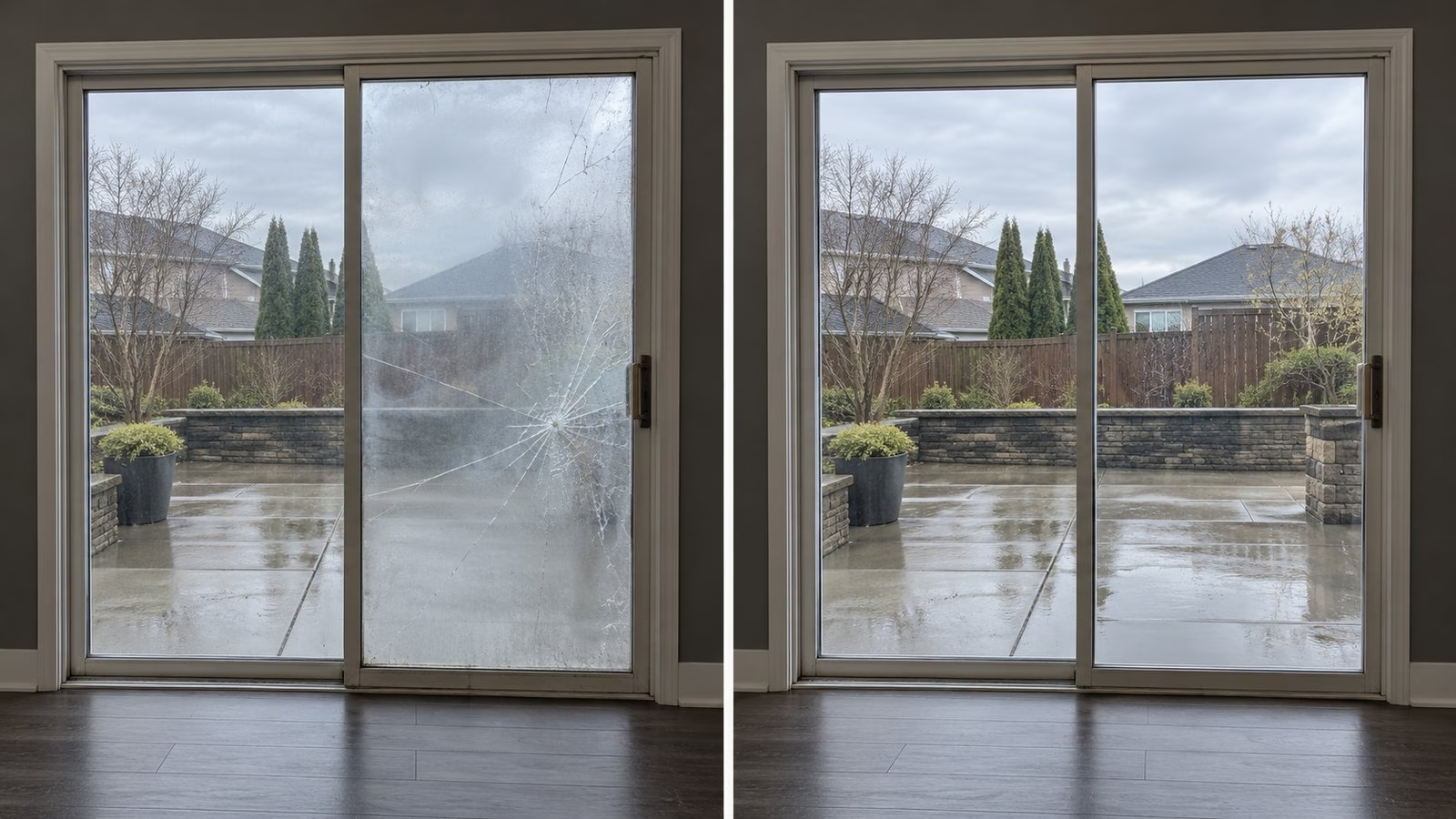
Updated October 2026 by UpgradeWorth Editorial. Federal glazing standard (16 CFR Part 1201), model-code glazing sections and manufacturer panel-replacement documentation checked on 5 October 2026. A method for deciding what kind of repair a sliding glass door actually needs, not a price list. How we research
Short answer first. Replacing only the glass in a sliding door is the sensible repair when everything around the glass still works: the main frame is square, the track is straight, the rollers carry the panel, the latch engages and the panel’s own frame is sound. When those parts are failing, or the old door cannot take the glass or panel you would need, a new door unit becomes the rational choice, because new glass in a failing system does not fix the system. Between those two sits a third job most people never hear about: replacing a whole movable panel in the existing frame. The frame, not the glass, usually decides which of the three you are buying. This page gives you the decision matrix and the line items each kind of quote should show.
Is this the right page?
This page is for one decision: glass only, a new panel, or a whole new door, for an existing sliding glass door. If you already know you are replacing the whole door and want planning ranges for it, the patio door replacement cost guide covers full-door cost, sliding against French and materials, and this page does not repeat any of it. If you have a hinged French patio door rather than a slider, the same reasoning applies, and the slab vs prehung decision tool handles the panel-or-unit question for hinged doors. If you already hold quotes for a new door, go to Compare Door Quotes.
Three different jobs share one search
“Sliding glass door glass replacement” is used for three jobs that differ in what is removed, who supplies the part and what is left behind. A quote that does not say which one it is pricing cannot be compared with one that does.
| 1. Glass / IGU only | 2. Movable panel (sash) | 3. Full door unit | |
|---|---|---|---|
| What is replaced | The sealed glass unit (IGU) inside an existing panel: two or more panes sealed around a spacer. | A complete panel, glass and panel frame together, set into the existing main frame and track. | Main frame, track, sill, every panel, and usually the screen and trim. |
| What stays | The panel frame, rollers, latch, main frame, track and sill. | The main frame, track, sill and the other panel. | Only the rough opening. |
| Who typically supplies the part | A glass shop or glazier, made to measure. | The door’s manufacturer or a parts dealer, ordered by series, size and handing. | A dealer or installer, as a new unit. |
| What has to be identified first | Glass size, overall thickness and make-up, and whether the panel can be reglazed at all. | Manufacturer, series, unit size, and whether it is the operating or the stationary panel. | Opening size, configuration and the scope of removal. |
| The quiet risk | New glass in a panel or frame that is already failing. | A panel that is no longer made, or one that fits but rides on a worn track. | Opening damage found only after the old door comes out. |
Path 2 is real and documented. Andersen, for example, sells complete gliding-door panels through its parts store, listed by series, unit size and operating or stationary position, and publishes separate panel replacement instructions for operating and stationary panels on some series. Its 100 Series handing guide reads the door from outside the house: X marks the operating panel and O the stationary one, so an XO unit has the operating panel on the left. Other makers handle parts differently, and older or discontinued lines may have no panel available at all. That availability is one of the things the matrix below turns on.
When the frame decides: the decision matrix
Find the row that matches what you can see, then read across. Fits means the path addresses the problem. Ask means it can work, but only if the condition in the cell is confirmed in writing. Wrong fix means the path leaves the actual failure in place. Where more than one row applies, the most demanding row wins.
| What you see | Glass / IGU only | Movable panel | Full door unit |
|---|---|---|---|
| Fog or moisture between the panes of one panel; the door slides, locks and seals well | Fits. This is the case glass-only replacement exists for. | Ask. Sensible if the panel cannot be reglazed, or a factory panel is the only way to keep the maker’s glass. | Wrong fix on this evidence alone. |
| Cracked or broken glass; panel frame undamaged | Fits, with safety glazing. See the code section. | Ask. If the glass is not separable from the panel, this becomes the glass repair. | Wrong fix on this evidence alone. |
| Hard to slide, jumps the track, latch will not catch, but the track itself is straight | Wrong fix. Glass is not the problem. | Wrong fix unless the panel frame is damaged. | Wrong fix. Rollers, adjustment and latch parts come first; see the repair table on the patio door cost guide. |
| Panel frame damaged: corners separating, panel bowed or twisted, glazing bead failing all round | Wrong fix. New glass in a failing panel. | Fits, if a matching panel is still made. | Fits when no panel is available. |
| Track bent, corroded or worn flat | Wrong fix. | Wrong fix. A new panel rides the same worn track. | Fits, unless the installer documents a specific track repair. |
| Main frame out of square: panels drag, gaps differ top to bottom, the lock only engages with force | Wrong fix. | Wrong fix. A square panel in an out-of-square frame still binds. | Fits. |
| Water at the sill after rain, soft flooring at the threshold, stains below the frame | Wrong fix. | Wrong fix. | Fits, with an opening-repair line. The sill and what is under it are the job. |
| Fog in both panels, or failed seals plus worn hardware on an older door | Ask. Two glass jobs on an ageing door can each fix a symptom without fixing the door. | Ask. Two new panels on an old frame and track. | Often the more rational choice. Compare all three priced in writing. |
| Manufacturer unknown, line discontinued, or no label anywhere on the door | Ask. A glass shop can often measure and make a unit; confirm the panel can be opened. | Usually unavailable. | Fits when the glass path fails. |
| You want a different performance: lower U-factor, different coating, laminated glass, an impact or design-pressure rating | Ask. Limited by the glass thickness the panel accepts. A rating belongs to a tested assembly; new glass does not create one. | Ask. Only within what that series offers. | Fits. Ratings and labels come with a specific new unit. |
| Single-pane glass or an early metal frame with no thermal break, and the room is uncomfortable | Wrong fix. The frame is the limit. | Usually unavailable. | Fits. |
Five checks before you ask for a quote
None of these needs tools beyond a tape measure and a flashlight, and each one points to a row in the matrix.
- Find the mark in the glass. Look in each corner of every pane for an etched or printed mark. Note what it says. It tells the glazier or dealer what the original glass was, and it is the first thing to check on new glass later.
- Find the maker. Look for a label on the frame edge, the head of the frame, the sill or between the panes on the spacer bar. Without a manufacturer and series, path 2 is usually closed.
- Work the door. Slide it fully open and closed, then lock it. Note whether it drags in one spot (often track or rollers) or all the way (often frame or panel).
- Measure the gaps. With the door closed, compare the gap between panel and frame at the top and the bottom on each side. Uneven gaps point to a frame or panel out of square.
- Check the sill. Look for stains, soft spots or gaps where the sill meets the floor, inside and out. Anything here moves you toward row 7 and a full-unit quote with an opening-repair line.
Safety glazing: the rule every path has to meet
This applies to glass-only repairs as much as to new doors, which is why it belongs at the top of any glass quote.
The federal standard names sliding doors directly. The Consumer Product Safety Commission’s Safety Standard for Architectural Glazing Materials, 16 CFR Part 1201, lists sliding glass doors (patio-type) among the products it covers, and defines a sliding glass door as an assembly of panels that includes both its movable and its fixed panels. Sliding glass doors are listed as Category II products, the higher of the standard’s two impact categories. The standard applies to glazing materials and the products that incorporate them, and it treats a fabricator who assembles glass into one of those products as a manufacturer.
The model codes call door glass a hazardous location. The 2021 International Residential Code, Section R308.4.1, says glazing in fixed and operable panels of swinging, sliding and bifold doors is a hazardous location. In the 2024 edition the glazing section moved to Section R324, and R324.4.1 carries the same sentence. The 2024 International Building Code, Section 2406, has the parallel rule and requires each pane of safety glazing in a hazardous location to carry a manufacturer’s identification, with limited exceptions.
Replacement glass is not exempt. The 2021 International Existing Building Code, Section 402.1, says replacement glazing in hazardous locations must comply with the safety glazing requirements of the building or residential code, as applicable.
Tempered glass is made to size. The federal definition of tempered glass notes it cannot be cut, drilled, ground or polished after treatment without fracturing. Replacement tempered glass is therefore ordered to the exact size, which is why measuring, ordering and a second visit appear on glass quotes.
What this does not tell you. Your city or county adopts its own code edition, may amend it, and decides whether your repair needs a permit or inspection. We are not your building official. What every path should state in writing is the glazing type for each pane and that it will be marked to show the standard it meets.
The quote line-item checklist
Each row is something that should appear separately on the quote for the path it is marked against. A blank is not a zero. It is an unknown, and the question in the last column is how you close it.
| Line item | Glass only | Panel | Full unit | Ask if it is missing |
|---|---|---|---|---|
| 1. Scope statement | Required | Required | Required | Which of the three jobs is this, and which panels does it cover? |
| 2. Glass make-up | Required | Required | Required | How many panes, which coating, what gas fill if any, what spacer, what overall thickness? |
| 3. Safety glazing and marking | Required | Required | Required | Tempered or laminated, for every pane, and will each pane carry a permanent mark? |
| 4. Measuring and ordering | Required | Required | Required | Who measures, what sizes are ordered, and who carries the cost if the size is wrong? |
| 5. Panel identity | — | Required | — | Manufacturer, series, unit size, handing, operating or stationary, and the part number. |
| 6. Glazing method | Required | — | — | Is the panel disassembled or the bead removed, and are bead, tape and sealant reused or new? |
| 7. Hardware and rollers | Ask | Required | Required | Do handle, lock and rollers transfer to the new panel, or come new? Are rollers adjusted or replaced? |
| 8. Track and main frame | Ask | Required | Required | Was the track inspected, and is any track work included, or excluded in writing? |
| 9. New unit specification | — | — | Required | Brand, series, size, configuration, frame material, glass package and label values. |
| 10. Removal, sill pan and flashing | — | — | Required | What comes out, and how the new sill is set, flashed and sealed. |
| 11. Opening-repair allowance | — | — | Required | What is included if rot or framing damage is found, and the unit price beyond that. |
| 12. Trim and finish | — | Ask | Required | Interior and exterior trim: new, reused or not touched, and who finishes it. |
| 13. Screen | — | Ask | Required | Is a screen included, reused or excluded? |
| 14. Disposal | Required | Required | Required | Who takes away the old glass, panel or door? |
| 15. Lead time and temporary closure | Required | Required | Required | How long until install, and is the opening secured in between if the glass is broken now? |
| 16. Permit | Ask | Ask | Ask | Has the contractor checked whether your jurisdiction requires one, and is it included? |
| 17. Warranty | Required | Required | Required | Glass seal term, product term, and the installer’s written workmanship term, separately. |
In homes built before 1978, full-unit removal disturbs painted surfaces, and federal EPA rules require certified renovators and lead-safe practices for that work. Ask whether the installer is certified and whether lead-safe work is in the scope.
Ask before signing: turn vague phrases into questions
| The quote says | What it leaves open | Send back |
|---|---|---|
| “Replace glass” | Glass only, or a whole panel? | Is this a new sealed unit in my existing panel, or a new panel? |
| “New IGU, low-E” | Which coating, gas, spacer and thickness? | Please list the full glass make-up for each unit. |
| “Tempered as required” | Every pane, or only some? | Will every pane in every unit be safety glazing, and marked? |
| “OEM panel” | Which maker, series and part? | Please give the manufacturer, series, size, handing and part number. |
| “Labor included” | Includes what, exactly? | Does labor include hardware transfer, roller adjustment, disposal and a return visit? |
| “Glass warranty” | Who stands behind it, and does it cover labor? | What is the seal-failure term, who honors it, and is reinstallation labor covered? |
| “Install new slider” | Removal, sill, flashing, trim, repairs. | Please list removal, sill pan, flashing, trim and the rot-repair allowance as separate lines. |
| “Door is beyond repair” | Which part failed? | Which part is beyond repair: glass, panel, track, frame or sill? Can you show me? |
The last row matters most. A recommendation to replace the whole door is often right, and the matrix says when. It should still name the failed part, because that part is what you are paying to fix.
Why two quotes for “the same door” can sit far apart
Homeowners regularly post a glass-shop quote and a door-dealer quote for the same slider that differ by a wide margin. We do not repeat those figures: they are single local jobs, and none is a national number. What they usually show is that the two quotes price different paths. One replaces a sealed unit and leaves everything else as it is; the other replaces the frame, track, sill and trim as well. Neither is a ripoff by default, and neither is a bargain by default. Put both against the line-item checklist, then decide which path the matrix says your door needs. For planning ranges on a full replacement, use the door replacement cost calculator, which shows its sources.
Check the warranty before you pay for glass
Manufacturer warranty cards often give glass its own terms, separate from the frame and hardware, and frequently exclude labor. If the door is recent enough to be covered, a failed seal may be a claim rather than a purchase. Find the series, check the card for your installation date, and ask who pays for the labor to swap the glass or panel. The door warranty guide explains how product and workmanship terms fit together.
Take your answer into the door tools
Two or three quotes
Compare Door Quotes
Tells you whether the quotes describe the same job in the same scope, or different jobs.
Full unit on the table
Door Replacement Cost Calculator
Published planning ranges for patio and entry doors, and the scope lines that move them.
One quote
Door Quote Analyzer
Sets what you asked for against what the quote prices and writes the questions to send back.
Related reading: patio door replacement cost, the door replacement quote audit and slab vs prehung vs full-frame. Everything else is at the Doors hub.
Common questions
Can you replace just the glass in a sliding glass door?
Usually, if the panel can be opened and reglazed and the frame, track, rollers and latch are sound. The new glass has to be safety glazing: sliding door panels, fixed and movable, are a hazardous location under the model codes, and replacement glass is held to the same rule.
When is a whole new sliding door the better choice?
When the failure is in the main frame, track, sill or opening, when several parts are failing together on an older door, or when you want performance or a rating the existing panel cannot give. New glass does not repair any of those.
What is the difference between a new glass unit and a new panel?
A glass unit is the sealed set of panes inside the panel. A panel is the whole movable or fixed section, glass and panel frame together, usually supplied by the door’s maker by series, size and handing.
Does the replacement glass have to be tempered?
It has to be safety glazing that meets the standard your code requires. Tempered glass is the common choice and laminated safety glass is another. Ask the quote to state the type for every pane and that each pane will be marked.
Why does a glass quote include a second visit?
Tempered glass cannot be cut after it is tempered, so replacement units are usually measured, ordered to size and installed on a later trip.
Does UpgradeWorth publish a typical price for sliding door glass?
Not on this page. Glass-only, panel and full-unit jobs are different purchases. Published planning figures for patio doors, with their sources, are on the patio door replacement cost guide.
Last verified: 5 October 2026. Sources: 16 CFR Part 1201, Safety Standard for Architectural Glazing Materials, sections 1201.1 (scope), 1201.2 (definitions, including sliding glass door, Category II and tempered glass) and 1201.4 (test procedures), as shown on eCFR; the 2024 International Residential Code, Section R324 and the 2021 edition’s Section R308; the 2024 International Building Code, Section 2406; the 2021 International Existing Building Code, Section 402.1; and Andersen’s patio door parts store, panel replacement instructions and handing guide, used for terminology only. Model codes apply only as adopted and amended by your jurisdiction. Homeowner discussions are treated as evidence of the question, not of any price. This page publishes no price, no national average and no product rating. We have not installed or tested any of these doors. Our methodology.
About the author
About UpgradeWorth Editorial. UpgradeWorth Editorial researches window, door and roofing costs for U.S. homeowners using manufacturer documents, public pricing data and homeowner quotes shared in public forums. We don’t sell products or take contractor fees, and we haven’t installed or lab-tested the products we cover. Spot an error? Contact us.
Next: holding two quotes for different paths? Put them through Compare Door Quotes. Pricing a full replacement? Start with the door replacement cost calculator. Everything else is at the Doors hub.