
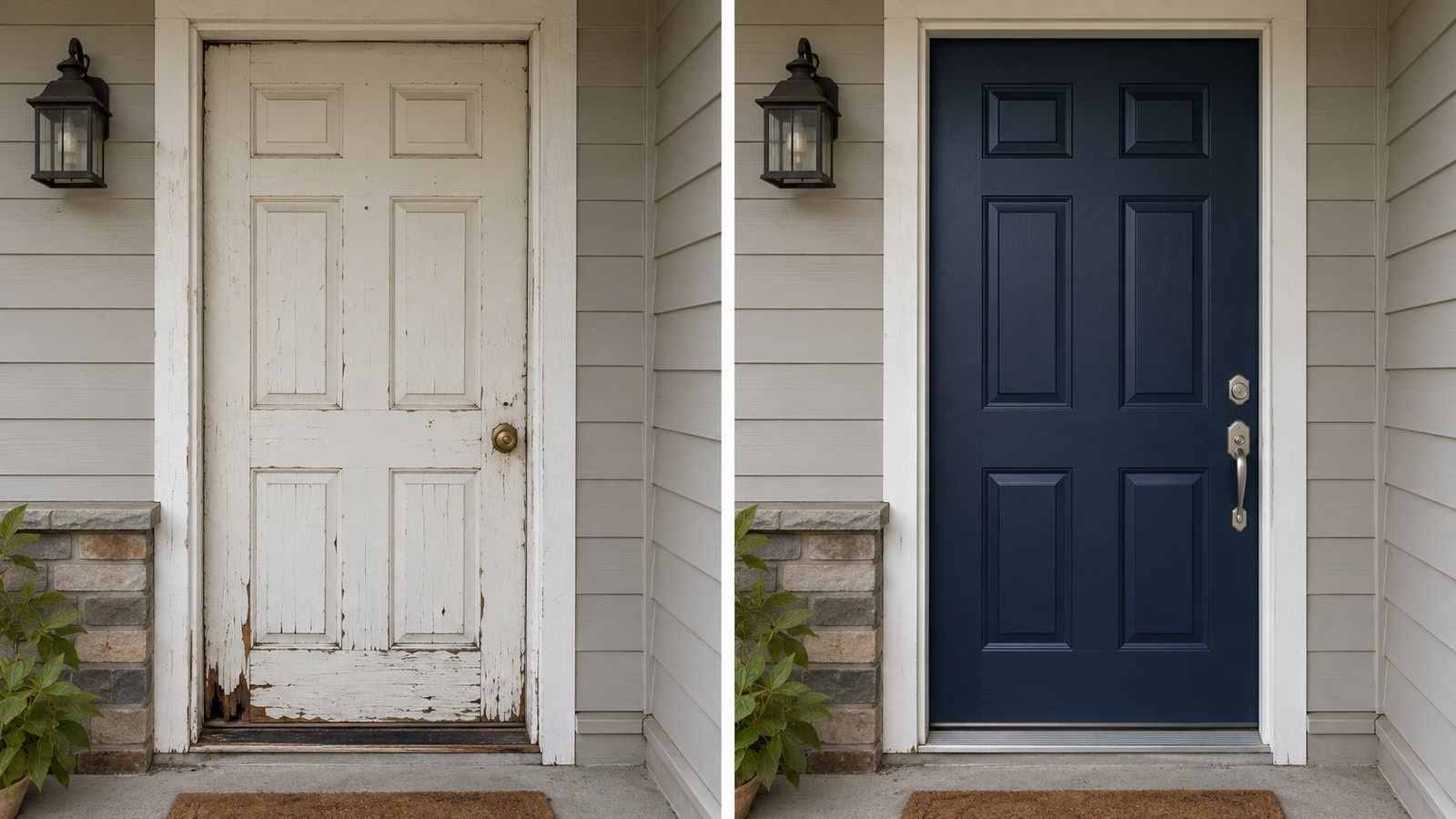
Updated October 2026 by UpgradeWorth Editorial. Manufacturer repair and installation documents, National Park Service wood-repair guidance and the federal lead-safe renovation rule checked on 6 October 2026. A method for deciding whether a front door needs a repair or a replacement, not a price list. How we research
Short answer first. Most front door complaints start as adjustment or wear-part problems: a hinge that has dropped, a strike that no longer lines up, a threshold set too low, a tired weatherstrip or door bottom. Those are repairs, and several of them take minutes. Replacement becomes the rational path when the failure is in the frame or the sill itself, when water keeps getting into the wood after it has been fixed, or when the only way to reach the failed part is to take the frame out anyway. This page puts the options in order, from the least invasive to the most, and names the points where you should stop patching and have the opening looked at in person.
Is this the right page?
This page answers one question: repair the front door you have, or replace it. It stops at the moment replacement becomes the path. Which kind of replacement you then need, a new door in the old frame, a new prehung unit, or the whole frame and sill out, is a separate decision, and it has its own guide: slab vs prehung vs full-frame, with the slab vs prehung decision tool to work through your own opening. Planning figures for a new door are in the front door replacement cost guide. If your problem door is a sliding patio door, the sliding glass door repair matrix is the better fit.
The repair ladder: six rungs, in order
Every front door repair sits somewhere on this ladder. Each rung costs more, disturbs more of the opening and needs more skill than the one below it. The rule is simple: start on the lowest rung that could plausibly explain what you see, and only climb when the rung you are on cannot fix it.
| Rung | What it involves | What has to be true first | Climb to the next rung when |
|---|---|---|---|
| 1. Adjust | Tighten or replace hinge screws, move or reset the strike, raise or lower an adjustable threshold. | The door and frame are undamaged; the problem is alignment or seal height. | Gaps stay uneven, or the seal still leaks once everything is adjusted. |
| 2. Replace wear parts | New weatherstrip, a new door bottom or sweep, and where the product allows it, a new threshold cap or sill deck. | The parts are available for your door, and the wood under and around them is sound. | The part sits on soft wood, or replacing it means taking the frame out. |
| 3. Local wood repair | Consolidate and fill decayed wood at the bottom of a jamb leg or the brickmould, or cut out the bad section and splice in new material. | The damage is small and confined, the wood around it is sound, and the water that caused it has been stopped. | Damage is on more than one member, reaches the sill, or comes back after repair. |
| 4. New door, old frame | Consider replacing only the door slab when the slab has failed and the frame has not. | The frame is sound, square and dry. | The frame is part of the problem. See the hand-off below. |
| 5. Prehung unit | A new door already hung in a new frame. | The rough opening behind the old frame can take the new unit. | The opening itself needs work once the old frame is out. |
| 6. Full-frame and opening work | Frame, sill and trim out, with any damaged framing or subfloor repaired before the new unit goes in. | An in-person assessment of the opening. | This is the top of the ladder. |
Rungs 1 to 3 are repairs. Rungs 4 to 6 are replacements, and this page deliberately says little about how they differ from each other: once you are there, the scope guide takes over.
Start from what you see
Find the row closest to your door. The middle column is where to start on the ladder, not where you will finish. Where more than one row fits, take the higher starting rung.
| What you see | Start on | Usually means | Stop and climb when |
|---|---|---|---|
| Draft or daylight under the door; the door otherwise closes well | Rung 1, then 2 | Threshold set too low, or a worn door bottom. | The threshold is soft, cracked or loose underfoot. |
| Draft or daylight along the latch side or the top | Rung 2 | Flattened, torn or missing weatherstrip. | Gaps are wider at one end than the other, which points back to rung 1 or to the frame. |
| Door rubs the frame near the top on the latch side, or the latch drops below the strike | Rung 1 | The door has sagged on its hinges, often a loose top hinge. | It still rubs after the hinges are tight and the screws hold. |
| Latch or deadbolt will not catch, but the door hangs evenly | Rung 1 | The strike is out of line with the latch. | The strike area of the jamb is split or crushed. |
| Paint peeling, wood dark or soft in the bottom few inches of one jamb leg or the brickmould | Rung 3 | Water has been sitting at the base of the frame. | Both legs are affected, the softness runs into the sill, or it has been repaired before. |
| Threshold cap or deck cracked, worn through or loose | Rung 2 | A worn part, if your threshold is built with a replaceable cap or deck. | Your product can only take a new threshold with the frame removed. |
| Door slab dented, cracked, split along an edge, bowed, or its glass has failed; the frame is fine | Rung 4 | The slab is the failed part. | The frame or sill also shows any of the signs above. |
| Gaps around the closed door differ top to bottom even after adjustment; the door latches only with force | Rung 5 | The frame may be out of square, or the opening may have moved. | Cracks in nearby drywall or trim, or a floor that has dropped at the threshold. Get it inspected. |
| Water on the floor inside after rain, stained or soft flooring at the threshold, stains on the wall below the door | Inspect first | Water is getting past the door or the frame into the building. | Always a stop sign. See the triggers below. |
For a structured way to look at the doorway itself, without taking anything apart, the scope guide has a five-minute checklist under what you can tell by looking. The table above is about which repair those observations lead to.
Rungs 1 and 2: the cheap fixes, done first
These are the repairs to rule out before anyone quotes a new door, because they are quick and because a new door does not fix them better than new parts would.
Threshold height. Many entry doors have an adjustable threshold, with screws under small caps in the raised strip below the door bottom. Masonite’s support page says turning those screws clockwise lowers the riser and counter-clockwise raises it, and warns that setting it too high can damage the sweep. Therma-Tru’s installation guidance offers a simple test for the result: with the door closed, you should only just be able to pull a dollar bill out from under it without tearing it.
Weatherstrip and door bottom. On many current doors the weatherstrip presses into a groove in the jamb. Therma-Tru’s homeowner instructions rate replacing it as a basic job of a few minutes: pull the old strip from the top down, press the new one into the groove and trim it. Replacing the door bottom is rated more involved, because the door comes off its hinges and the new bottom is sealed and stapled on before the threshold is readjusted. Masonite says replacement weatherstrip and sweeps come through its dealers and home centers. The practical step is to identify the door’s maker first, because the profile has to match.
Hinges and strike. A door that rubs at the top latch corner has usually dropped on its hinges. Check that every hinge screw is tight and holding. Therma-Tru and ProVia installation instructions both call for 2½-inch #10 screws at the hinges, so a top hinge held only by short screws that spin in their holes is worth looking at first. If the door hangs evenly but the latch misses, the strike is the part that moves.
Threshold parts. Whether a worn threshold is a part or a project depends on how it is built. Some adjustable thresholds take a new cap: Therma-Tru’s repair manual describes removing the adjustment screws, swapping the cap and readjusting. Endura’s Replaceable Deck Sill is designed so the deck slides out and a new one slides in without removing the sill or the door unit. ProVia’s field instructions for replacing its thresholds start with taking the frame out of the opening. If replacing your threshold means the frame comes out, you are no longer on rung 2, and that is one of the triggers below.
Rung 3: local repairs to rotted wood, and their limits
A soft spot at the bottom of a jamb leg is the classic front-door problem, and it is the rung where repair and replacement are most often argued over. Two things decide it: how far the decay goes, and whether the water that caused it has stopped.
How far it goes. The National Park Service’s guidance on repairing historic wood, written for windows and porches but describing the same materials and failures, says the extent of decay can be found by probing gently with an awl, and that decay can sit under a surface that looks sound. That is a job for whoever is assessing the repair, not a reason to dig into your frame. The NPS describes the options in rising order: saturate partly decayed wood with an epoxy consolidant and rebuild it with an epoxy patching compound; or cut out the damaged section and fit new wood in its place, a splice or a dutchman; or replace the part. It also notes epoxies are only for painted surfaces, because they do not take stain and break down in sunlight.
Whether the water has stopped. The same guidance puts it plainly: wood kept continuously damp is where decay fungi grow. A repair at the bottom of a jamb leg with the same splash, the same missing gutter and the same failed seal above it is buying time, not fixing the door. Before rung 3, find out where the water comes from. If it is coming through the door system itself, rather than from rain splash or a missing gutter, that question belongs to an inspection.
Where rung 3 ends. Local repair is reasonable for a confined patch on one member, with sound wood around it, once the water source is dealt with. It stops being reasonable when the decay is on both jamb legs, runs from a jamb into the sill, has been repaired before, or cannot be bounded without removing trim. Then the repair is effectively rebuilding the frame in place, and a new frame becomes the comparison to price.
What we cannot tell you from here. Nobody can judge how far rot goes, whether the sill or subfloor is wet underneath, or whether the framing around a door has moved, from a description or a photo. That is found out by someone standing in your doorway, and sometimes only once trim comes off. Treat everything on this page as a way to frame the question, not as an answer about your door.
Threshold-only replacement: decision checklist
The threshold is the one part of a front door where can we just fix that single piece is a genuine question, and the answer turns on two things: how the threshold was built, and what the sill underneath it is doing. On some designs the cap or deck is a service part; on others, replacing the threshold begins with taking the frame out of the opening. This checklist is for deciding which path your opening is a candidate for, before a contractor quotes a full door. It is not a structural diagnosis; a soft, wet or shifting sill is always a reason to have someone look at the opening in person.
| What you see at the threshold | What it tends to point to | What it rules in |
|---|---|---|
| Cap, deck or wear strip cracked, worn through or no longer meeting the sweep | The top wear layer has failed | Cap or deck swap on designs built for it; otherwise a full threshold job. |
| The threshold is loose at the ends where it meets the jamb legs | The seal where the sill meets the jamb has failed | At minimum, resealing or re-fastening; often threshold replacement. |
| Fasteners sitting proud, with sound wood around them | Movement at the fasteners alone | Re-fastening and resealing on the existing threshold. |
| The sill flexes, dips or feels soft underfoot | The sill or what is under it is wet or decayed | Opening-level work, not threshold-only. Have it inspected. |
| Softness, swelling or dark staining running from the threshold into either jamb leg | Decay has reached members a new threshold does not touch | Full-frame conversation. See the triggers above. |
| Wet, soft, stained or swelled flooring, subfloor or interior trim at the threshold line | Water has reached the building, not only the door | Inspection first. Threshold-only is not the question yet. |
| A previous threshold replacement has already failed in the same opening | The water source was not resolved last time, or the sill was already compromised | Treat this as a replacement conversation, not another threshold. |
Which repair paths your threshold is a candidate for. Masonite’s support page covers adjusting a threshold with its riser screws. Therma-Tru’s repair manual describes removing the adjustment screws and swapping the cap on designs built for a cap swap. Endura’s Replaceable Deck Sill is designed so the deck slides out and a new one slides in without the sill or the door unit coming out. ProVia’s threshold field replacement, by contrast, begins by removing the frame from the opening. The maker and model of your door decide which of these your opening is a candidate for. Where the only way to replace the threshold is to pull the frame, the decision is no longer threshold-only, and the scope guide takes over.
What a threshold-only quote should state.
- The exact part being replaced — a cap, a deck or the whole threshold — and whether the frame comes out to do it.
- The maker and model of the replacement part, and that it is compatible with your existing door and sill.
- What is being done at the ends where the threshold meets the jamb legs, which is where sill seals most often fail.
- Whether the sill pan and flashing beneath are inspected, and what happens if either is found to be the problem.
- A written statement of what is excluded, most relevantly framing, subfloor and jamb repairs if any are needed once the old threshold is out.
The exterior door measurement checker captures the opening and existing threshold details that let you tell whether a listed replacement part fits, before an installer visit. If you already have a quote in hand, the door quote analyzer sets what the quote describes against what the opening needs.
Lifting a threshold can expose more than the quote covers. Taking the old threshold out can show wet or decayed sill boards, subfloor, or the backs of the jamb legs. A threshold-only quote is reasonable when nothing in the table above applies; it stops being reasonable the moment any of the sill-level signs do. Ask, in writing, what happens — and what it costs — if the opening is not as expected once the old threshold is lifted.
Stop patching and get the opening evaluated when…
Any one of these is enough to stop adding repairs and ask a door installer, a carpenter or a home inspector to look at the opening in person. Several together usually mean a replacement conversation, and possibly opening work.
- Water is reaching the inside. Wet or stained flooring at the threshold, soft subfloor, stains on the wall or trim below the door, or swelling of interior trim.
- The sill or threshold gives underfoot. A sill that flexes or feels soft when you step on it is not a wear-part problem.
- Decay is on more than one part. Both jamb legs, a jamb leg and the sill, or the brickmould and the jamb behind it.
- A repair has failed before. The same spot was filled, patched or spliced, and it is soft or open again.
- Adjustment did not fix the fit. With hinges tight and the strike reset, the gaps are still uneven top to bottom, or the door only latches with force.
- The opening shows movement. New cracks in drywall or trim near the door, or a floor that has dropped at the threshold.
- The part you need means the frame comes out. A threshold that cannot be replaced in place, or a jamb repair that cannot be done without pulling the whole frame. You are paying for removal either way.
- Two failures on one old unit. The slab has failed and the frame is worn as well. Two repairs to an ageing door can each fix a symptom without fixing the door.
- You cannot see where the damage ends. Softness that disappears behind trim, siding or the floor covering. That boundary is exactly what an in-person inspection is for.
None of these is a structural diagnosis. They are the points at which the next repair is a guess, and a guess on a door that is already letting water in is how a sill problem becomes a floor problem.
Once replacement is the path
When the answer is replacement, the next decision is how much to replace: the door alone, a prehung unit, or the frame and sill back to the opening. The trade uses overlapping words for those jobs, which is why two quotes can both say “new door” and price different work. The slab vs prehung vs full-frame guide explains the two decisions involved and what a quote must say about sill pans and flashing, and the slab vs prehung tool takes your answers about the jamb, the sill and the opening and returns the paths that fit, with the questions to send installers.
One thing worth carrying across from this page: if rot was what pushed you to replace, ask what the bottom of the new jamb is made of. Some manufacturers build the lowest part of the jamb from a different material for exactly this reason. Therma-Tru, for example, says its rot-resistant jambs have Alaskan yellow cypress finger-jointed to the bottom of each leg, and Endura’s FrameSaver frames use a composite bottom section under wood above. What the warranty says about frame rot is a separate question, covered below.
What the repair quote should actually say
| The quote or the visit says | What it leaves open | Ask |
|---|---|---|
| “Door needs replacing” | Which part failed? | Which part has failed: hinge, strike, seal, threshold, slab, jamb, sill or opening? Can you show me? |
| “Adjust door” | What was adjusted, and was anything replaced? | Which adjustments, and if the fit does not hold, what is the next step? |
| “Rot repair” | Which members, by what method, and what if there is more? | Which pieces are being repaired, is it filled or spliced, and what happens if the damage goes further than expected? |
| “Replace threshold” | A cap or deck, or the whole sill with the frame out? | Does this replace the cap or deck in place, or does the frame come out? |
| “Replace jamb” | The bottom of one leg, a whole leg, or the frame? | Exactly which length of which jamb, and what material goes in? |
| “Seal the door” | Seal what, against which water? | Where is the water coming from, and how does this stop it there? |
The first row matters most. A recommendation to replace is often right, and the triggers above say when. It should still name the failed part, because that part is what you are paying to fix. Once a replacement quote is on the table, the door replacement quote audit lists what it has to state before you compare it with another.
Check the warranty before you pay for a repair
If the door is recent, read the warranty before you buy parts. Door warranties tend to separate the door, the frame and the labor, and the frame line is where rot lives. Therma-Tru’s FAQ, for one, says wood deterioration arising from a frame system is not covered unless the frame is a genuine Therma-Tru rot-resistant component, and that its limited warranty excludes labor, including installation of replacement products. Other makers word it differently, and your document is the one that governs. The door warranty guide shows how to find it and how product and installation terms fit together.
Older homes: the lead-safe rule applies to repairs too
In homes built before 1978, paid work that disturbs painted surfaces falls under the EPA’s Renovation, Repair and Painting rule, which requires certified firms and lead-safe work practices. The rule’s definition of renovation gives the modification of painted doors as an example, and even lists planing a threshold to fit weatherstrip. Its minor-repair exception covers only small areas: 6 square feet or less of painted surface per room inside, or 20 square feet or less outside. Adjusting a hinge on a painted door is unlikely to approach that; a frame repair or removal on a painted opening may exceed it. The EPA says the rule does not apply to homeowners working on their own pre-1978 home, unless it is rented out, used for childcare or renovated for resale, but the dust is the same either way. If a contractor is doing the work, ask whether the firm is certified and whether lead-safe practices are in the scope.
Take your answer into the door tools
Replacement is the path
Slab vs Prehung Door Tool
Five steps on the jamb, the sill and the opening, and the replacement paths that fit what you describe.
Repair quote and replacement quote
Compare Door Quotes
Shows whether two quotes describe the same job and the same scope, or two different jobs.
Pricing a new door
Door Replacement Cost Calculator
Published planning ranges for entry doors, with the scope lines that move them and the sources behind them.
Holding a single replacement quote? The door quote analyzer sets what you asked for against what it prices. Everything else is at the Doors hub.
Common questions
Can a rotted door jamb be repaired instead of replaced?
Often, if the decay is confined to a small area at the bottom of one jamb leg, the wood around it is sound and the water causing it has been stopped. The usual methods are an epoxy consolidant and filler, or cutting out the damaged section and splicing in new material. When decay is on both legs, runs into the sill or returns after repair, replacement becomes the comparison to price.
Is it cheaper to repair or replace a front door?
A repair on rungs 1 to 3 is usually far less work than a new door, which is why it comes first. It is only the cheaper choice if it fixes the failure. A repair that has to be repeated, or that takes the frame out anyway, can end up costing more than doing the replacement once. Planning figures for replacement are in the front door replacement cost guide.
How do I know if the problem is the door or the frame?
If the gaps around the closed door are even and the door has a visible defect, such as a split edge, a bow or failed glass, the slab is the likely problem. If the gaps stay uneven after the hinges and strike are adjusted, or the bottom of the frame is soft, the frame is involved. An installer can confirm it in person.
Can I replace just the threshold?
It depends on how the threshold is built. Some designs take a new cap or deck in place; others can only be replaced with the frame out of the opening. Find the maker and model first. If the sill underneath is soft, a new threshold on top does not fix it.
What can make a threshold-only replacement insufficient?
The threshold is the top of a stack: cap or deck, then the sill boards, then the sill pan and flashing, then subfloor and framing. A new threshold renews the top layer only. If the sill is soft, if water has reached the subfloor, if the pan is torn or missing, or if either jamb leg is decayed where it meets the sill, a new threshold is a cosmetic fix on a wet problem. The second-column signs in the threshold decision checklist are the ones that put you in that situation.
Why would a contractor quote a full door when the problem looks like a bad threshold?
Two reasons, and they are different conversations. On many designs the threshold itself cannot be replaced without taking the frame out, so a full-frame quote reflects what the product requires, not what the opening needs. On other openings the sill or subfloor is also involved, so a threshold-only quote would not fix the real failure. Ask which of those two reasons applies, and whether a new threshold would be enough if nothing worse is found under the old one.
Why is water getting in at the bottom of my front door?
It may be as simple as a threshold set too low or a worn door bottom, which are wear-part fixes. Water that reaches the floor, the subfloor or the wall below the door is a different matter, and it is a reason to have the opening inspected before any repair.
Does UpgradeWorth publish repair prices?
Not on this page. Repairs on different rungs are different jobs, and we do not publish figures we cannot source. Replacement planning ranges, with their sources, are in the door replacement cost calculator.
Last verified: 6 October 2026. Sources, each opened on that date: Masonite’s support FAQ (threshold adjustment and replacement parts); Therma-Tru’s weatherstrip and door bottom replacement instructions, its installation guidance (threshold test and hinge screws), its repair and replacement manual (2017, threshold cap replacement) and its FAQ (rot-resistant jambs, frame and labor warranty terms); ProVia’s entry door installation manual (v3.2, hinge screws) and threshold field replacement instructions (v1.0); Endura’s Replaceable Deck Sill and FrameSaver product pages; National Park Service Preservation Briefs 9, The Repair of Historic Wooden Windows and 45, Preserving Historic Wood Porches, used for repair methods and the role of moisture; and the EPA’s Renovation, Repair and Painting program with 40 CFR 745.83 (definitions). Manufacturer documents are cited as examples of how products are built and serviced, not as a ranking. Homeowner discussions about rotted jambs informed which questions this page answers; none is quoted and none is used as evidence of a price or an outcome. This page publishes no price, no national figure and no product rating. We have not inspected your door, and we have not installed or tested any of these products. Our methodology.
About the author
About UpgradeWorth Editorial. UpgradeWorth Editorial researches window, door and roofing costs for U.S. homeowners using manufacturer documents, public pricing data and homeowner quotes shared in public forums. We don’t sell products or take contractor fees, and we haven’t installed or lab-tested the products we cover. Spot an error? Contact us.
Next: decided it is a replacement? Work out the scope with the slab vs prehung tool. Holding a repair quote and a replacement quote side by side? Put them through Compare Door Quotes. Everything else is at the Doors hub.