
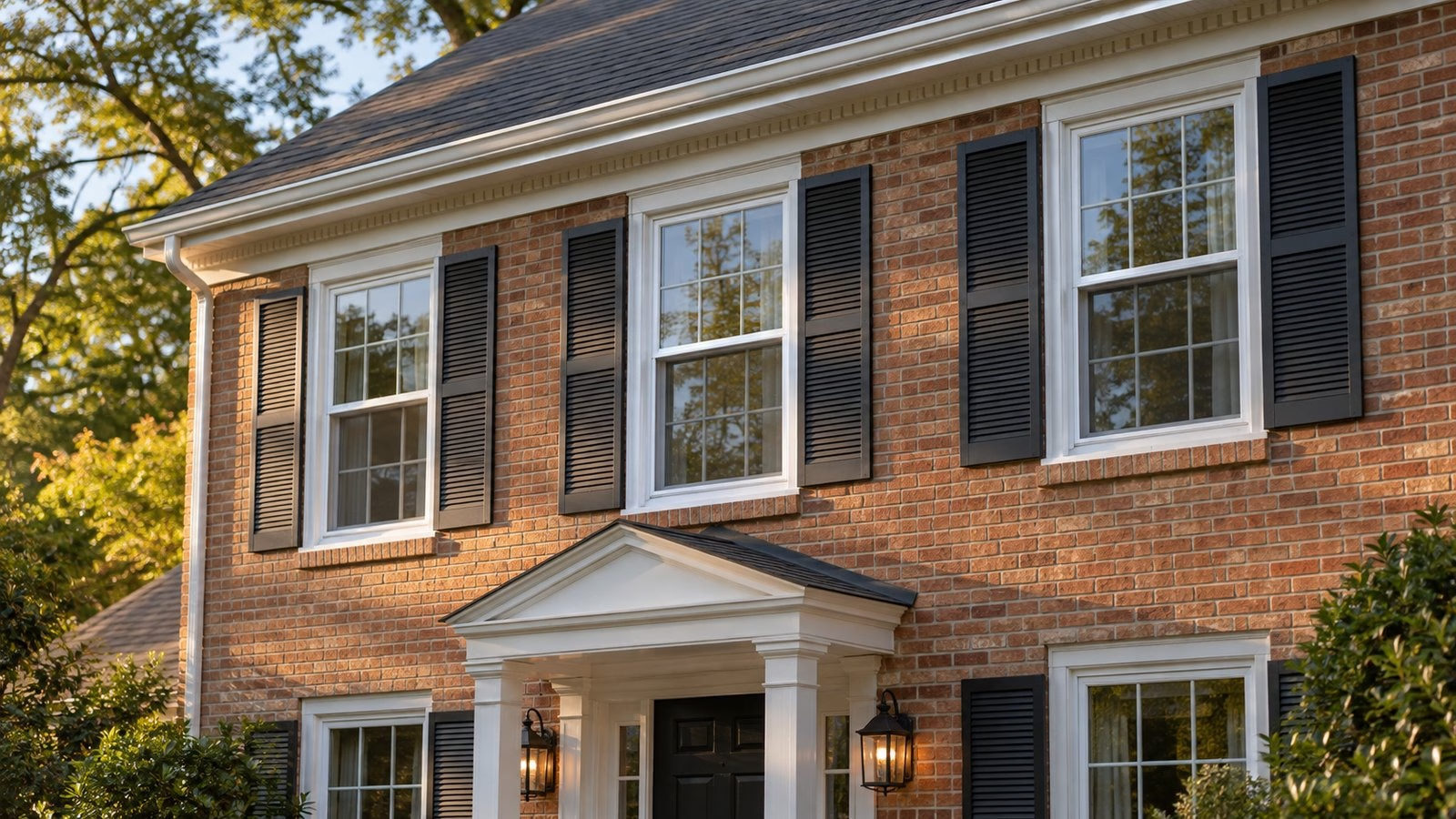
There isn’t a single lifespan for vinyl windows. How long yours last depends on how they were built, how they were installed, what weather they face, how you maintain them, and which part fails first. Many vinyl windows reach the end of their useful life one component at a time rather than all at once — an insulating glass seal here, a worn balance there — so the right question is usually which parts are failing on your specific windows, not whether the whole unit has “expired.”
If you want a rule of thumb, the one most often cited by home inspectors is InterNACHI’s Standard Estimated Life Expectancy Chart, which lists vinyl/fiberglass windows at 20 to 40 years and double-pane insulating units at 8 to 20 years. InterNACHI is careful about this number: the chart is “a general guideline and not as a guarantee or warranty,” assumes recommended maintenance and normal wear, and specifically excludes extreme weather. For coastal regions, InterNACHI’s Florida chart shortens vinyl/fiberglass to 10 to 30 years and double-pane units to 5 to 15. The widely circulated “20 to 40 years” figure attributed to the NAHB/Bank of America 2007 Life Expectancy study does not actually appear there — that study lists only aluminum (15–20), wood (30+), and window glazing (10+). There is no vinyl row.
What usually fails first on a vinyl window
Thinking about a vinyl window as a system of parts is more useful than thinking about it as one object with an expiration date. Below is a symptoms list — what tends to go wrong and what each symptom usually points to. This is not a statistical ranking of failure order; it’s a reference for matching what you’re seeing to the component underneath.
| Symptom | What it usually means | Typically repairable? | When it points to replacement |
|---|---|---|---|
| Fog, haze, or moisture between the panes | Insulating glass (IG) seal failure — gas has escaped and moisture is condensing inside the sealed unit | Yes, usually by swapping the IG unit if the sash and frame are sound | Many sashes/IGUs across the house, obsolete sash profile, or the original brand is gone |
| Sash drops, won’t stay up, or feels heavy | Balance (spring or spiral) is worn or broken | Yes — balances are a wear part and are often stocked | Only when the sash itself is also distorted or the model is unsupported |
| Drafts, whistling, or visible light at the sash edge | Weatherstripping has hardened, torn, or compressed; or the sash isn’t seating | Yes — strips can be replaced and sash adjusted | If the sash or frame has warped so weatherstrip can’t seat |
| Lock won’t latch or feels loose | Hardware wear, misalignment, or sash sag | Yes — replace the lock, cam-keeper, or adjust | Rarely points to full replacement on its own |
| Vinyl warping, cracking, discoloration, or visible gaps at corners | Frame or sash is failing — heat cycling, UV, impact, or a weak weld letting go | Sometimes, if limited to one sash on a supported model | Yes, when frame is distorted or multiple corners have opened |
| Water on the sill, stains on drywall below the sill, peeling paint | Installation, flashing, or exterior caulk is failing — often not the window itself | Yes — re-flash and re-caulk, repair sill if rotted | When the rough opening or wall has to be rebuilt |
A fogged pane is the one most people notice first, and it’s a good example of why “the window” and “a part of the window” shouldn’t be collapsed. The Efficient Windows Collaborative (an NFRC program) describes IG seal failure as the loss of insulating gas and moisture penetrating between the panes, which can also degrade low-E coatings. The same source notes that “insulating glass failure rates differ greatly depending on the quality of seal systems and manufacturers’ quality assurance” — so two vinyl windows installed the same year, in the same house, can age very differently. We go deeper on this in fog between window panes, and on the draft side of things in new windows feel drafty.
What changes the number: build, climate, install
Three things do most of the heavy lifting on how long a vinyl window actually lasts.
How the window is built. Welded corners (versus mechanically fastened), internal reinforcement in the meeting rail or jamb, sash rigidity, the type of IG spacer, and whether the IG unit was certified under a recognized program all show up over time. The Efficient Windows Collaborative points out that “design and workmanship may be the most important factors determining the long-term durability of sashes and frame,” and that since 2010, insulating glass in ENERGY STAR windows must be certified through recognized programs that include accelerated weathering testing. Our vinyl vs. fiberglass windows comparison walks through where frame material actually matters.
Climate and exposure. Vinyl expands and contracts with temperature; the Efficient Windows Collaborative notes that newer vinyl designs have improved dimensional stability and resistance to UV and temperature extremes, but a south- or west-facing wall in a hot climate still asks more of the frame than a north wall in a mild one. Coastal salt is a separate stressor: “some materials are degraded by salt near the ocean,” which is why InterNACHI’s coastal chart lists shorter ranges for both vinyl frames and double-pane units. For wind and wind-driven rain, the Efficient Windows Collaborative suggests looking at the window’s Performance Grade (PG) or Design Pressure (DP) rating, especially in exposed locations.
Installation. This is often the deciding factor. The Efficient Windows Collaborative calls proper installation “crucial” to avoiding air and water leakage and damage to both the window and the surrounding wall. The U.S. Department of Energy’s homeowner guide to Repairing Windows & Doors is blunt about the limit case: full replacement is “the only option when the existing window frame is damaged beyond reasonable repair or when the surrounding wall requires substantial repair.” It also warns that insert (pocket) replacements don’t address air leakage at the existing frame’s edge, which is a common surprise when a drafty window is replaced into a bad opening.
What we deliberately don’t do here is publish lifespan bands by price tier (entry/mid/premium). No credible source we’ve seen attaches a numeric lifespan to a tier — and the only authority that gives any vinyl figure at all (InterNACHI) presents it as a general guideline, not a product forecast.
Repair, part replacement, or whole-window replacement
Most of the time, the decision isn’t “do I keep these windows or replace them all,” it’s “what’s the smallest fix that solves the actual problem?” The matrix below is how we think about it. For the deeper walk-through, see repair vs. replace windows, and if you want to put your situation into numbers, the window repair vs. replace calculator runs the comparison.
| Situation | Repair the part | Replace the glass unit or sash | Replace the whole window |
|---|---|---|---|
| One isolated hardware or balance failure | Yes — order the part and swap it | Only if the part is bonded into the sash | No |
| One foggy IG unit, sash and frame are sound | N/A | Replace the IGU (or the sash, if the IGU isn’t serviceable) | Only if the model is unsupported and no IGU can be ordered |
| Air leakage traced to weatherstrip or sash seating | Replace weatherstrip, adjust sash | Replace sash if it’s warped | If the frame itself has racked |
| Visible frame distortion, cracked welds, or sash won’t close square | No | Replace sash only if frame is still true | Yes — frame is the problem |
| Water intrusion at the sill or stains below | Investigate flashing, pan, caulk | Rare — usually not a glass or sash issue | Only when the frame or rough opening is compromised |
| Multiple simultaneous defects across many windows | Not practical | Case by case | Often the better value, especially if units are the same age and brand |
Two things worth flagging when a contractor pushes “replace everything.” First, DOE’s point about insert windows is real: if the existing frame has air-leak issues, an insert doesn’t fix them — a full-frame replacement does. Second, several of the symptoms above (water at the sill, drafts around the trim) are often not window defects at all, but installation and flashing issues on the existing opening, which a new window won’t automatically solve.
Warranty length is not the same as service life
Homeowners often read a “lifetime” warranty as a lifespan forecast. It isn’t. The NAHB study’s own disclaimer says its figures should be used as general guidelines only, “not as a representation, warranty or guarantee regarding the life expectancy or performance of any individual product.” InterNACHI says the same. And manufacturers routinely state the opposite outright — Pella’s current vinyl warranty includes a specific line that “This Limited Warranty is not a statement of the useful life of any Pella products,” and Milgard’s 2026 warranty says “Milgard makes no representation regarding the useful life of its Product.”
What a warranty actually tells you is which parts the manufacturer will stand behind, for how long, under what conditions, and whether labor is included. The examples below are drawn from the current manufacturer documents — read as examples, not comparisons. Always read your own warranty certificate, because terms vary by product line and change over time.
| Manufacturer example | Frame / non-glass | Insulating glass | Labor | Transfer |
|---|---|---|---|---|
| Pella Vinyl Window & Patio Door Limited Warranty (2023 WVP0217) | Limited Lifetime, owner-occupied single-family, nontransferable; converts to a transferable 10-year warranty when ownership transfers or the home ceases to be owner-occupied | Nonlaminated glass 20 years against seal failure or permanent obstruction of vision; laminated glass 10 years; blinds/shades between glass 5 years | Labor included only within 2 years of the date of sale | Lifetime term is not transferable; the 10/20-year parts are transferable |
| Milgard Replacement Product Warranty (effective Nov. 1, 2026) | Lifetime Limited for the Residential Dwelling Owner while they own and occupy; 10 years for all other owners (including commercial, HOA, rental, subsequent owners) | IGU 20 years for Residential Dwelling Owner / 10 years all others; stress cracks 1 year; delamination in laminated/impact IGU 10 years | Skilled Labor and shipping covered for claims within 10 years of Manufacture Date if the structure is in Milgard’s Service Territory; non-skilled labor not covered | Transferable — each owner is responsible for passing it on |
| ProVia Aeris, Endure & Aspect Windows and Patio Doors (Ver 1.0, 03/15/2024) | Basic unit (rigid vinyl and factory-applied wood components): Lifetime while the original purchaser owns and lives in the home; transferable to one subsequent purchaser if registered within 30 days of transfer | Insulated glass with Super Spacer: Lifetime for the original purchaser while they own and live in the home | Replacement part shipped to the nearest authorized dealer; the purchaser pays all labor and transportation from the dealer | Basic unit warranty transferable to one subsequent purchaser; coastal applications and non-residential installations have shorter terms |
Exclusions that show up again and again across these documents: improper installation, condensation caused by indoor humidity, customer-applied window films, tints, or paint, and lack of routine maintenance. Milgard also spells out that caulking or sealants between the window and the exterior cladding “is not part of the Product and is not covered by this Warranty — it is a maintenance item that is the responsibility of the Owner,” which is a position most manufacturers take in one form or another. For more on reading a warranty, see how to read a window warranty or dig into the specifics in our breakdowns of the Pella window warranty, the Milgard warranty, and the ProVia warranty. If you want to check what your own warranty still covers, the window warranty checker walks through it.
A quick homeowner checklist before you call anyone
You can learn most of what you need to know in about twenty minutes with a flashlight and a notepad. Doing this before an installer visit changes the conversation from “sell me new windows” to “here’s what my windows are actually doing.”
At each window, check: fog or haze between the panes; whether the sash raises, stays up, and locks; drafts at the sash edges or meeting rail (a lit candle or a thin tissue near the seam helps); water or staining on the sill or wall below; cracks, warps, or opened corners in the vinyl frame or sash. Note which windows are affected and which face south or west — patterns matter.
Questions worth asking any installer or service tech: Is the problem the insulating glass unit, the sash, the hardware, or the frame? Can the IG unit or the balance be ordered as a service part for this model? Is my original warranty still active, and if the home has changed hands, did it transfer? If you’re replacing, is this quote for an insert (pocket) replacement or a full-frame tear-out, and why?
What to compare on replacement quotes: the scope (insert vs. full-frame), the IG specification (spacer type, gas fill, low-E coating), the frame construction (welded corners, reinforcement), the warranty text and whether labor and transfer are included, and whether exterior flashing and interior trim are part of the price or not. Our window quote checklist lays this out line by line, and the window replacement cost guide covers what’s typically in or out of a bid.
FAQs
Do 20-year-old vinyl windows automatically need to be replaced? No. Twenty years lands inside InterNACHI’s general guideline range for vinyl/fiberglass windows, but the chart is explicit that it is a guideline, not a forecast for any specific product. If your windows still operate well, lock, don’t fog, and don’t leak, they don’t need to be replaced on the basis of age alone. Look at the parts, not the number.
Does fogging between the panes mean the whole window has to go? Not usually. Fog between the panes points to the insulating glass unit’s seal, not the sash or frame. On most mainstream vinyl windows, the IG unit (and often the whole sash) can be replaced as a service part if the sash and frame are sound and the brand/model is still supported. See fog between window panes for how to confirm it and what the fix typically involves.
Can vinyl frames be repaired? In a limited way. Small nicks and scratches can be buffed out of vinyl surfaces, and hardware, weatherstripping, balances, and glass units are all routinely serviceable. What generally isn’t repairable in the field is a cracked weld, a bowed or warped frame, or a sash whose profile has distorted enough that it no longer seats — those cases usually point to sash or whole-window replacement.
Does a lifetime warranty mean the window lasts a lifetime? No. Manufacturers themselves say so — both Pella and Milgard explicitly state in their current warranties that the warranty is not a statement of useful life. A lifetime warranty tells you what the manufacturer will do if a covered defect appears while you still own and occupy the home, and under what conditions. It is not an estimate of how long the window will perform.
Before you sign a quote
If you’ve gotten this far, you probably have at least one quote in front of you — or you’re about to. Before you sign anything, run the quote through our window quote analyzer: it checks scope, IG spec, warranty, and the usual gotchas against what a complete quote should include. If you still aren’t sure whether a repair would do the job, the repair vs. replace decision tool compares the two paths on your actual situation.
Sources
- NAHB / Bank of America, Study of Life Expectancy of Home Components, February 2007. PDF copy. Accessed November 3, 2026.
- InterNACHI, Standard Estimated Life Expectancy Chart for Homes. nachi.org/life-expectancy.htm. Accessed November 3, 2026.
- InterNACHI, Estimated Life Expectancy Chart for Florida Homes. nachi.org/florida-life-expectancy.htm. Accessed November 3, 2026.
- Efficient Windows Collaborative / National Fenestration Rating Council (NFRC), Guidance on Window Durability. efficientwindows.org/new-durable. Accessed November 3, 2026.
- U.S. Department of Energy, Office of Energy Efficiency and Renewable Energy, Repairing Windows & Doors: How To’s for the Handy Homeowner. PDF. Accessed November 3, 2026.
- Pella Corporation, Pella Vinyl Window & Patio Door Limited Warranty, ©2023, WVP0217 (file Vinyl-warranty_8-29-23_current.pdf). Accessed November 3, 2026.
- Milgard Manufacturing LLC, Milgard Replacement Product Warranty, effective November 1, 2026. Accessed November 3, 2026.
- ProVia LLC, Aeris, Endure & Aspect Windows & Patio Doors Lifetime Limited Transferable Warranty, Ver 1.0, 03/15/2024. Accessed November 3, 2026.